Multitasking - I: Half Here, Half Scrolling.
Quick Summary - We like to think we’re multitasking - answering messages, skimming emails, and jumping between tabs like pros. But science tells a different story: our brains aren’t multitasking, they’re rapidly switching, and each switch comes at a cost. Attention fragments, productivity drops, and stress quietly builds. In Part II, we’ll explore what this means for marketing and branding.
3 min read
Multitasking - I
Half Here, Half Scrolling - The quiet cost of multitasking in a world that never pauses.
May I have your attention, please?
Actually - are you sure you still have it?
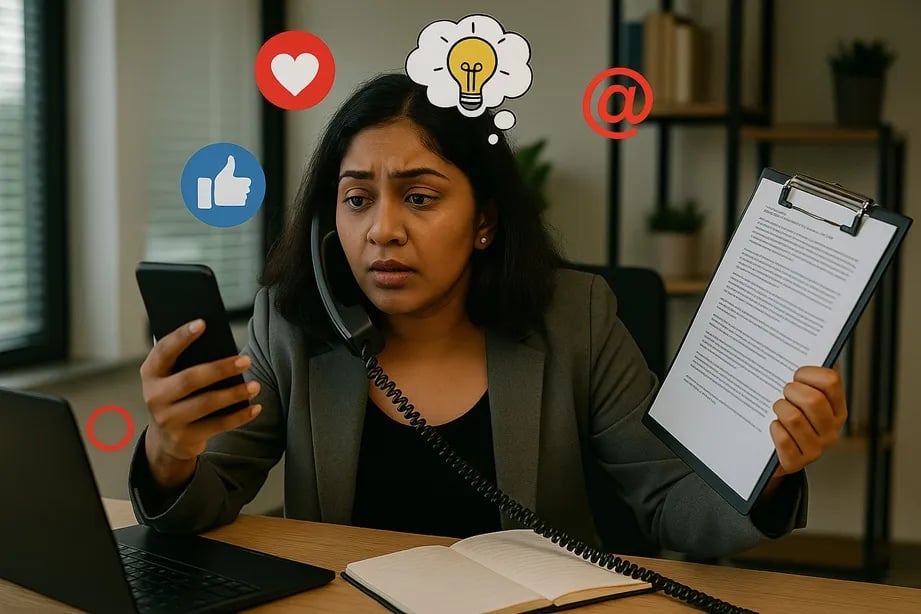
Statistically speaking, you may have checked your phone since starting this sentence. Or mentally wandered into that one unresolved WhatsApp chat. Or opened your laptop to “focus,” only to fall into the black hole known as Google Calendar.
According to cognitive scientist Dr. Gloria Mark, the average person now switches tasks every 47 seconds. That’s just long enough to start something, get distracted, feel bad about it, and open another tab to cope.
We call it multitasking. Science calls it cognitive switching. And it comes at a cost - in energy, clarity, and the slow erosion of our ability to finish a paragraph without remembering we left tea steeping an hour ago.
Your Brain Is Not a Browser
The brain can’t juggle. It toggles - one thing at a time, spotlight-style. Multitasking is like trying to listen to two songs at once and somehow enjoy both. Or cooking and texting and wondering why your pasta turned into paste.
Psychologist Dr. David Meyer found that task-switching can lower productivity by up to 40%, especially in tasks that require real thought - like writing, planning, or trying to remember your UPI pin under pressure.
Each switch drains working memory and increases the odds that you’ll forget what you were doing, why you started, or where your last coherent thought went.
We Interrupt Ourselves Now
In most modern settings, the distraction isn’t coming from the phone - it’s coming from inside the house (read: your own brain).
We reach for our devices in lifts. At traffic lights. Mid-conversation.
We read a sentence, then suddenly we’re ordering coffee beans online because - who knows? - maybe caffeine will give us back our focus.
We’ve trained ourselves to chase stimulation like a squirrel with six tabs open.
It’s not productivity. It’s just polite panic.
The Cost of Constant Switching
In field studies by Dr. Mark, even minor interruptions had ripple effects:
Higher stress levels
Worse mood
People reported feeling “mentally scattered” (technical term: brain soup)
And the kicker?
“We found that when people did email, they were in a bad mood.”
Which is science-speak for - email is emotionally expensive and likely to ruin your lunch break.
It’s not about how long each task takes. It’s about the accumulated cost of switching - like paying a toll every time your brain changes lanes.
Soft Fixes, Not Shiny Tricks
Some tools work with your mind instead of against it. Binaural beats, for instance - tones played slightly out of sync in each ear, prompting your brain to generate a calming rhythm of its own.
In one 2022 study, kids who listened to alpha and beta waves performed better on memory and attention tasks. And unlike productivity hacks that require color-coded dashboards and 4 AM wake-ups, this one just needs a pair of headphones and a willingness to sit still.
It’s not a life-changer. But it’s a gentle nudge - the cognitive equivalent of someone dimming the lights and saying, “Take your time.”
The Deeper Truth
Multitasking isn’t a badge of honor.
It’s a permission slip for being perpetually distracted.
Presence - the act of doing just one thing - now feels rebellious.
It’s:
Eating without watching
Listening without checking
Writing without toggling
Slowness isn’t laziness. It’s focus. And in a world optimized for speed, focus is the real flex.
Final Thought
Because attention isn’t just about getting things done. It’s about feeling things fully. Finishing what you started.
And remembering what mattered, long after you closed the tab. Because attention isn’t just about getting things done. It’s about feeling things fully. Finishing what you started. And remembering what mattered, long after you closed the tab.
Coming Next:
In Part II, we’ll explore what this means for marketing and branding. If attention is this fragile - how do we stop hijacking it and start honoring it instead.
Multitasking - I
Half Here, Half Scrolling.
Connect
Explore
sumeet.pahwa@gmail.com
© 2025. 2026 Sumeet Pahwa. All rights reserved