Multitasking – II: Branding in Distracted World.
Quick Summary - Picking up from Multitasking - Part I, this blog dives deeper into the realities of branding in a multitasking world. With consumers constantly distracted, the real challenge for brand custodians is no longer visibility - it’s memorability.
NEXT 4
4 min read
Multitasking – Part II: How Brands Can Win in the Age of Divided Attention
Consumer isn’t paying attention. Not to your brand. Not to your campaign. Sometimes, not even to their own decisions.
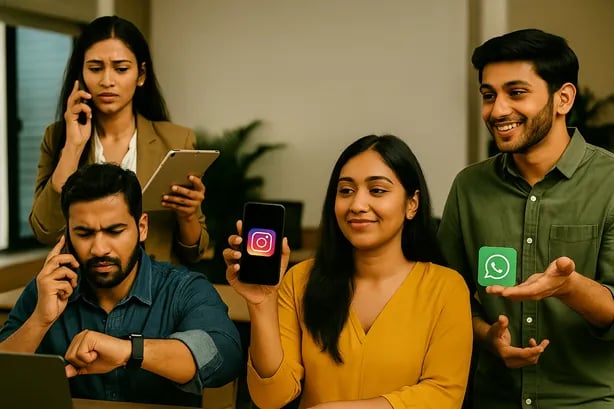
Today’s consumer lives in a whirlpool of distractions - watching IPL while DMing on Instagram, browsing Flipkart while on a Teams call, or scanning through WhatsApp forwards while half-listening to a podcast.
Brand custodian’s challenge isn’t just to be visible. It’s to be memorable, relevant, and pause-worthy - even when attention is fragmented.
Welcome to the Attention Economy 2.0 - where everyone is multitasking, and no one is fully present.
On an average Indian smartphone user interacts with their phone over 4.7 hours a day, among the highest globally. Indian users interact with mobile apps over 100 times daily on average - often in bursts of multitasking, short attention and rapid switching - making India one of the most app-active markets globally.
The average session on any single platform? Often less than 30 seconds. And during that time, they're likely watching IPL or YouTube or Netflix or something else, replying to a meme on WhatsApp, and pretending to listen to a Teams call.
In other words of marketing parlance, a brand has 0.7 seconds to matter.
So, what should brand custodians do?
Do we fight it? Resist the tide of fractured attention?
Of course not. That would be like shouting at traffic.
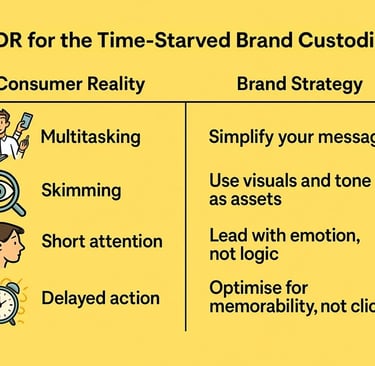
Instead, we adapt. We build brands for fragmented minds, and messages that land even when people aren’t listening properly.
1) Consumers Don't Think Much, They Don't Need To
Behavioral economist Daniel Kahneman taught us that the brain runs on two systems:
System 1 (fast, intuitive, emotional) - This system is intuitive with little or no effort. This thinking mode allows us to make quick decisions and judgements basis past patterns & experiences.
System 2 (slow, logical, deliberate) -This requires conscious and intentional effort. It is used for complex, problem-solving and analytical situations, where deep thinking and consideration is needed.
Guess which one makes 95% of purchasing decisions?
(Hint: It's the one that also impulse-buys Rs. 1,200 candles on quick commerce at midnight.)
A Nielsen study (in India) found that emotionally charged ads had 23% higher brand recall than rational, fact-heavy ones. Why? Because emotion sneaks past cognitive fatigue.
Brand Opportunity:
Don’t over-explain. Seduce. Signal. Simplify.
Think Cadbury’s “Kuch Meetha Ho Jaaye” — emotional, cultural, and timeless, even when half-heard.
2) Your Logo Isn’t a Signature. It’s a Shortcut
Byron Sharp argues that the most valuable asset a brand has is mental availability - how easily it comes to mind in buying moments.
And mental availability is built through distinctive brand assets.
In a multitasking world, people don’t read ads. They skim vibes.
Timeless Example:
Amul’s topical cartoons are iconic. Even if you don’t read the whole pun (and sometimes they’re very punny), the format itself is a distinctive asset. You stop. You smile. You remember.
Brand Opportunity:
Audit your digital presence. Is your Instagram grid visually unique? Does your reel feel like you - even with the sound off and no attention on?
3) Adapt Message to Moment (Don’t Just Resize the Creative)
A brand shouting "Big Sale!" on Instagram, on LinkedIn, on YouTube, and in your inbox is not multichannel. It's multi-annoying.
Multitasking consumers aren’t just distracted - they’re doing different things in each context.
System 1 may be scanning reels for entertainment, while System 2 is pretending to learn Excel on a Coursera tab. Your message has to match the mode.
Quick Examples:
E-commerce brand (Outdoor + Hyperlocal Context)
Imagine, an e-commerce brand crafting location-specific messages:
Billboard outside IT parks: “Meetings can wait. Biryani can’t.”
Near metro or bus stations: “By the time you reach home, we’ll be there too.”
Why it works: It reads the environment and mirrors back a relatable insight - converting a mundane moment into a micro-brand memory.
Quick-Commerce Push/Email Copy
A Q-Com brand takes over - weirdly specific, scroll-stopping copy that turns push notifications into delightful interruptions.
“Your fridge called. It’s lonely.”
“Broccoli doesn’t buy itself.”
“Don’t let hunger interrupt your binge.”
Why it works: It’s conversational, low-pressure, and tuned to the emotional logic of multitasking. You don’t need to think — just feel amused, intrigued, and maybe… tap.
Brand Opportunity:
Make your copy and creative context-native.
Not one-size-fits-all. One-size-fits-here.
4) Memory Trumps Clicks
Multitasking may reduce engagement rates - but what if that’s the wrong metric?
Neuroscience research shows that brand impressions formed subconsciously are more durable than rational ones. Meaning, the ads we barely notice… still shape preference later.
You’re not selling in that moment. You’re planting brand memory seeds.
A Case In Point:
Tanishq’s emotional stories rarely hard-sell, but they’re unforgettable. When you are ready to buy jewellery, you think of them. And not just because they said "20% off on making charges."
Brand Opportunity:
Optimise for emotion, not just clicks. Even low-engagement moments build brand salience when your tone is consistent and memorable.
5) Make the Brand ‘Pause-Worthy’ (But Not Desperate)
Good branding doesn’t shout. It nudges, charms, and gets invited back.
In an environment where your ad competes with wedding playlists, WhatsApp forwards, and the fifth delivery notification of the day, subtlety isn't weakness - it’s strategy.
The best brands don't interrupt attention. They earn a smirk, spark curiosity, or feel like a friend with excellent timing.
A Case In Point:
Think about Zomato’s sending push notifications which are better than the food.
“Even your fridge deserves a break.”
“Paneer > Plans.”
That’s not conversion copy - it’s conversation copy.
Brand Opportunity:
Write copy for people who are half-scrolling. Make them smile, not just swipe.
Closing Thoughts
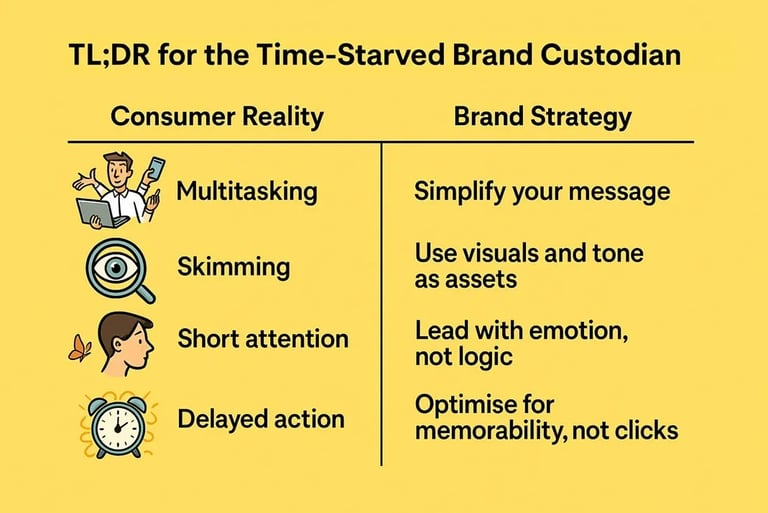
People don’t just juggle tasks - we juggle languages, contexts, and platforms. The modern brand custodian’s job is not to “capture” attention. It’s to design for distraction - to be the message that cuts through clutter not by shouting louder, but by saying something simpler, smarter, or strangely delightful.
You’re not just competing with brands. You’re competing with cricket scores, meme shares, and friends & relatives sending "Good Morning" GIFs at 6:13 AM.
Connect
Explore
sumeet.pahwa@gmail.com
© 2025. 2026 Sumeet Pahwa. All rights reserved