
The Mind Doesn’t Reflect. It Reframes.
Quick Summary - The Mind Doesn’t Reflect. It Reframes., felt like the right place to start. Because nothing matters more than understanding the frame through which we see the world. The mind isn’t a mirror - it’s a storyteller, an editor, a meaning-maker. And to connect with anyone (even ourselves), we must first learn how that storytelling works. So this is the beginning. A quiet one.
3 min read
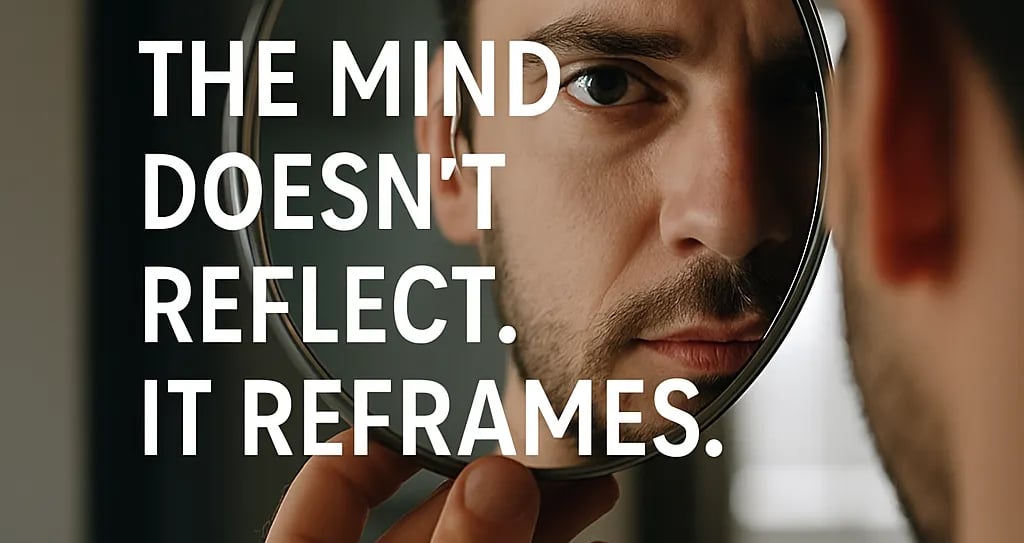
Most people assume the mind is a mirror - clear, objective, and passive. That it simply records what is. But the truth is more nuanced, and far more interesting: the mind does not reflect reality. It reframes it.
We don't see the world. We see our version of it—filtered, shaped, and edited by a dynamic internal system that’s constantly rewriting the script. And to truly connect with others - or even with ourselves - we must first understand how this reframing engine works.
Welcome to the first whisper.
The Pattern-Making Machine
The mind doesn't just observe - it compulsively seeks patterns. It's our brain’s way of bringing order to chaos. We see faces in clouds, meaning in randomness, and stories in symbols. It's called apophenia, a term first coined by German neurologist Klaus Conrad.
This tendency isn’t accidental. According to neuroscientist Karl Friston’s predictive coding theory, the brain is constantly predicting what it expects to see, updating its internal model based on how reality does - or doesn’t - match those predictions.
This is why we gravitate toward narratives, rituals, and belief systems. They provide form to formlessness. But sometimes, our pattern-making instincts jump too quickly, filling in blanks that don’t need to be filled. That’s where distortions begin.
The Mind as a Personal Algorithm
Now think of your mind as a kind of living algorithm. It evolves from past data—your experiences, memories, fears, wins, and mistakes. It trains itself over time, refining a mental model of what the world is supposed to be.
When something new shows up, it doesn’t analyze it from scratch. It checks: Have I seen something like this before? If yes, it reacts accordingly.
Psychologists Daniel Kahneman and Amos Tversky explored how we make these snap judgments using heuristics - mental shortcuts that help us survive but often lead to biases and errors.
That’s why two people can walk out of the same meeting with completely different conclusions. It’s not just about what happened - it’s about what their minds were trained to see.
This is where mindfulness becomes more than just a wellness buzzword. Mindfulness is a disciplined practice of watching the mind at work—without judgment. It creates a space between thought and action, between perception and projection. By cultivating awareness of our mental patterns, we begin to loosen their grip. We can respond rather than react. We stop being the software, and start observing the code.
In this light, mindfulness isn’t passive. It’s subversive. It disrupts the auto-pilot. It makes way for fresh perception.
Time: The Quiet Case Study
Let’s take time as an example. It’s supposed to be objective, right? Thirty minutes is thirty minutes.
But not in the mind.
A boring meeting might drag on forever. But a good conversation can pass in the blink of an eye. When we’re bored, time slows. When we’re fully absorbed, time disappears.
This was explored by psychologist Mihaly Csikszentmihalyi in his work on the Flow State - a state where our skills meet the challenge, and our sense of time dissolves.
Cognitive neuroscience has a view on this too. Studies show that when we’re focused - when our attentional load is high - our brain’s internal clock becomes disrupted. The mind stops tracking time and starts tracking meaning.
So time, like reality, is just another thing the mind interprets, not experiences.
Why This Matters
So, what’s the takeaway?
If reality is shaped by internal models, not external facts, then understanding someone isn’t about explaining better - it’s about understanding their lens.
You may present logic, clarity, even truth—but it gets filtered through another person’s experiences, memories, and internal biases. That’s why persuasion isn’t power. Empathy is.
This insight matters everywhere. Whether you're a marketer, salesperson, coach, leader, or just someone navigating personal relationships - understanding how the mind works can add immense value to your daily life.
And that understanding begins with a humbling truth, well articulated by neuroscientist David Eagleman:
“Humans are able to thrive in many different environments… this is possible because the human brain is born remarkably unfinished.”
Eagleman’s point goes beyond biology. An unfinished brain is an adaptive brain. It means our minds aren’t fixed - they're sculpted moment by moment through experience. And because of this plasticity, we’re always one insight away from reframing how we see ourselves, others, and the world.
That’s what Whispering Dot is about: those tiny vibrations that shift how we think.
A Whisper to Begin With
The mind is not a lens. It’s a painter. It doesn’t just reflect - it creates. Shapes. Colors. Chooses.
And at the heart of that process is a dot - a small, vibrating moment of insight. A feeling. A flicker. A shift.
That’s where meaning begins.
And that’s what Whispering Dot is about: tuning into that subtle start - the almost-silent place where perception becomes perspective, and thought takes form.
In a world loud with conclusions, this is a space for beginnings.
One dot at a time.
Connect
Explore
sumeet.pahwa@gmail.com
© 2025. 2026 Sumeet Pahwa. All rights reserved